Coaching & Performance
How to Become a Strength and Conditioning Coach: Complete Guide
15 min read

So, you're thinking about becoming a strength and conditioning coach? It's an incredible field, but it's not something you just fall into. The whole journey really rests on three key pillars: getting the right degree, earning a top-tier certification like the CSCS, and—this is the big one—spending a ton of time in the trenches gaining hands-on coaching experience.
This profession is as much an art as it is a science. You have to know the textbook principles inside and out, but you also need the intuition and people skills to apply them on the gym floor.
Your Roadmap to a Career in Strength and Conditioning

Becoming a great strength and conditioning coach isn't a one-and-done deal. It's a constant process of learning, adapting, and refining your craft. At its core, this job is about understanding the science behind human performance and translating that into practical, effective training programs that get athletes to the next level.
Make no mistake, this path is incredibly rewarding, but it demands serious dedication. You're not just there to count reps. You're a scientist, a mentor, and a critical part of an athlete's support system. Your job is to make athletes stronger, faster, and more resilient, all while keeping them healthy and on the field.
What to Expect on This Journey
Before we get into the nitty-gritty of degrees and certs, let's zoom out. You need to grasp the foundational pillars of this career—the absolute must-haves that every employer, from a local high school to a pro team, is going to look for.
This guide will break everything down for you, but it helps to see the big picture first. It's a logical progression: you build your academic base, prove your knowledge with a respected certification, and then apply it all in the real world.
The path to becoming a strength and conditioning coach is a marathon, not a sprint. Success is built on a foundation of scientific knowledge, validated credentials, and the irreplaceable experience gained from countless hours on the training floor.
To help you map out your journey, here's a quick look at the core components. This table lays out the essentials, giving you a clear idea of the requirements and the time you'll need to invest.
Core Pillars of Becoming a Strength and Conditioning Coach
The table below breaks down the three non-negotiable pillars of this career. Think of it as your high-level checklist for getting started.
| Pillar | Typical Requirement | Estimated Timeline |
|---|---|---|
| Education | Bachelor's Degree in a related field (e.g., Kinesiology, Exercise Science) | 4 Years |
| Certification | Gold-standard credential (e.g., CSCS, SCCC) | 3-6 Months of Study |
| Experience | Internships, volunteer work, assistant coaching roles | 1-2+ Years |
Each of these pillars builds on the last, creating the well-rounded expertise that separates a good coach from a great one.
Building Your Foundation with Education and Certifications

Sure, the weight room is where you'll make your mark, but the classroom is where you build the blueprint. Think of your education as the essential starting block—it gives you the scientific language to understand why certain training methods get results. Without it, you're just a rep counter.
Employers, especially in college and pro sports, see a degree as a sign of your commitment. It proves you've put in the work to understand the incredibly complex machine that is the human body. This academic grounding is what separates a professional coach from a weekend fitness enthusiast.
Choosing the Right Degree Path
When you're picking a major, the goal is simple: immerse yourself in the science of human performance. Your degree isn't just a piece of paper; it's the intellectual foundation for every single program you'll ever design. It teaches you how to think critically about everything from biomechanics to metabolic adaptation.
For anyone serious about this career, a few degree paths are the most direct routes to the top.
- Exercise Science: This is the classic choice, and for good reason. It's a comprehensive look at how the body responds to physical stress, covering everything from exercise physiology to motor control.
- Kinesiology: Often considered a cousin to Exercise Science, Kinesiology is literally the study of human movement. You'll go deep on biomechanics, anatomy, and how the nervous system orchestrates every squat, sprint, and jump.
- Sports Medicine or Athletic Training: These degrees bring a stronger clinical perspective. That knowledge is invaluable for understanding injury prevention and rehab protocols—a huge part of keeping athletes on the field.
Whichever path you take, make sure your coursework is loaded with anatomy, physiology, biomechanics, and nutrition. These aren't just classes; they are the absolute bedrock of effective coaching.
The Certification That Opens Doors: The CSCS
A degree gives you the "why," but a certification proves you know the "how." It's the credential that tells a hiring manager you can actually apply all that science safely and effectively in a high-stakes environment. And in the world of strength and conditioning, one certification is the undisputed king.
That credential is the Certified Strength and Conditioning Specialist (CSCS) from the National Strength and Conditioning Association (NSCA). For countless jobs in college and professional sports, having a CSCS isn't a suggestion—it's a requirement. It immediately tells people you're a serious professional.
For many athletic directors and head coaches, seeing "CSCS" after a candidate's name is the first filter they use. It's a powerful signal of credibility and competence in a crowded field.
Don't underestimate the challenge, though. The CSCS exam is notoriously tough, designed to weed people out. It tests both deep scientific knowledge and practical application, which is precisely why it's so respected. In a recent year, the NSCA tested 6,196 candidates, and the pass rate was just 55%. With exam fees at $340 for members and $475 for non-members, it's a serious investment of time and money. You can discover more insights about the strength and conditioning certification market and its growth.
Navigating Other Key Certifications
While the CSCS is the most recognized certification on the planet, it's not the only game in town. Depending on your specific career goals, another option might be an even better fit—especially if you know for a fact you want to work in the college setting.
The main alternative is the Strength and Conditioning Coach Certified (SCCC) from the Collegiate Strength and Conditioning Coaches Association (CSCCa).
CSCS vs. SCCC: A Quick Comparison
The two biggest players have different philosophies and requirements. Here's a quick breakdown:
| Feature | CSCS (NSCA) | SCCC (CSCCa) |
|---|---|---|
| Focus | Broad application (pro, college, tactical, private) | Exclusively collegiate athletics |
| Prerequisites | Bachelor's degree, CPR/AED certified | Bachelor's degree, CPR/AED, plus a mandatory internship under an approved mentor |
| Recognition | The global standard across all sports sectors | The gold standard specifically within NCAA Division I |
| Process | Pass a challenging two-part exam | Complete the mentorship, then pass written and practical exams |
The non-negotiable, structured mentorship is what truly sets the SCCC apart. This requirement guarantees that candidates have significant, supervised floor time before they can even sit for the exam. It's a huge reason why the SCCC is held in such high regard by university athletic departments.
In fact, the NCAA now mandates that all Division I strength coaches hold an accredited certification. This rule highlights the industry-wide push for higher standards and athlete safety, making credentials like the CSCS and SCCC more critical than ever.
Getting Your Hands Dirty: Gaining Essential Coaching Experience
Textbooks and certifications give you the "what" and the "why." They build your scientific foundation. But the weight room floor? That's where you learn the art of coaching. This is where neat, tidy exercise science collides with the messy, unpredictable, and amazing reality of working with actual human beings.
Frankly, meaningful experience is the only currency that really matters when you're trying to break into this field. It's about way more than just logging hours. You're learning how to deliver the right cue to the right athlete at just the right moment, how to command a room of 30 antsy athletes, and how to build the kind of trust that makes them want to run through a wall for you.
Finding and Nailing Down Valuable Roles
Everyone will tell you to "get an internship," and they're not wrong. But that's just the start. Your real goal is to find places where you can do the thing, not just stand in a corner holding a clipboard. You need reps, a place to practice your craft, make mistakes, and learn from coaches who've been in the trenches for years.
Think outside the box and start local. Your first gig probably won't be with a Power 5 football program, and that's okay.
- Volunteer at a Local High School: Most high school programs are underfunded and would kill for a dedicated, knowledgeable volunteer. It's a fantastic place to learn group management and see firsthand how to develop younger athletes.
- Connect with Private Performance Gyms: Find the local gyms training athletes in your area. Shoot them an email or even stop by. Offer to help set up, spot, or assist with classes in exchange for mentorship. You'd be surprised how many are willing to take on an eager apprentice.
- Target University Internships: These are the big ones for a reason. They provide a structured curriculum, access to dozens of different sports, and a direct pipeline into the college coaching network. Just be ready—the application process is usually pretty competitive.
The most important thing is to be proactive. Don't just wait for a perfect opportunity to pop up on a job board. Identify coaches and programs you admire, write a professional email explaining what you're trying to learn, and ask if you can come in to observe or volunteer. A little humility and a genuine hunger to learn will get you far.
What Separates a Great Internship from a Resume-Filler
Listen, not all experience is created equal. A great internship will light a fire under you and fast-track your development. A bad one will have you fetching coffee and re-racking weights for 20 hours a week. You have to be smart about where you invest your time.
When you're looking at an opportunity, find out if it's a program that will let you grow beyond just being an observer.
A valuable internship is one where you transition from watching to doing. You should be given more and more responsibility over time—from leading warm-ups to demonstrating exercises, and eventually, to helping with program design and athlete assessments.
Before you say yes to anything, ask about your potential day-to-day. Will you get opportunities to practice your coaching eye? Will you get to mess around with any tech, like force plates or timing gates? The best programs are genuinely invested in building up the next generation of coaches, not just using interns as free labor.
Document Everything and Build Your Network
As you start getting hours, keep a meticulous log of everything you do. This isn't just for your resume; certifications like the SCCC require proof of a specific number of mentored hours.
Create a detailed spreadsheet or document that tracks:
- The organization and your supervising coach's name.
- The exact dates and hours you were there.
- Which teams or athletes you worked with.
- A quick rundown of your duties for each session.
This log becomes your proof of work—tangible evidence of your commitment. But beyond the paperwork, focus on building real relationships. The strength and conditioning world is incredibly small, and your reputation starts building from day one of your first volunteer gig.
The connections you make as an intern are often the same ones that will get you your first paid job. Show up early. Stay late. Ask smart questions. Work harder than everyone else. That's how you turn hands-on experience into a career.
Navigating Your Career Path and Salary Expectations
You've done the work. You've hit the books, earned your certifications, and put in the hours on the floor. Now what? The world of strength and conditioning is bigger and more varied than most people think, stretching far beyond the bright lights of college and pro sports.
Figuring out where you fit best is the key to a long and fulfilling career. Each sector has its own vibe, its own daily grind, and its own path for advancement. Knowing what to expect—both in terms of your job and your paycheck—will help you make smart moves from day one.
This infographic breaks down the typical journey many of us take, starting with unpaid volunteer work and building up to paid coaching roles. It's a rite of passage for many in this field.
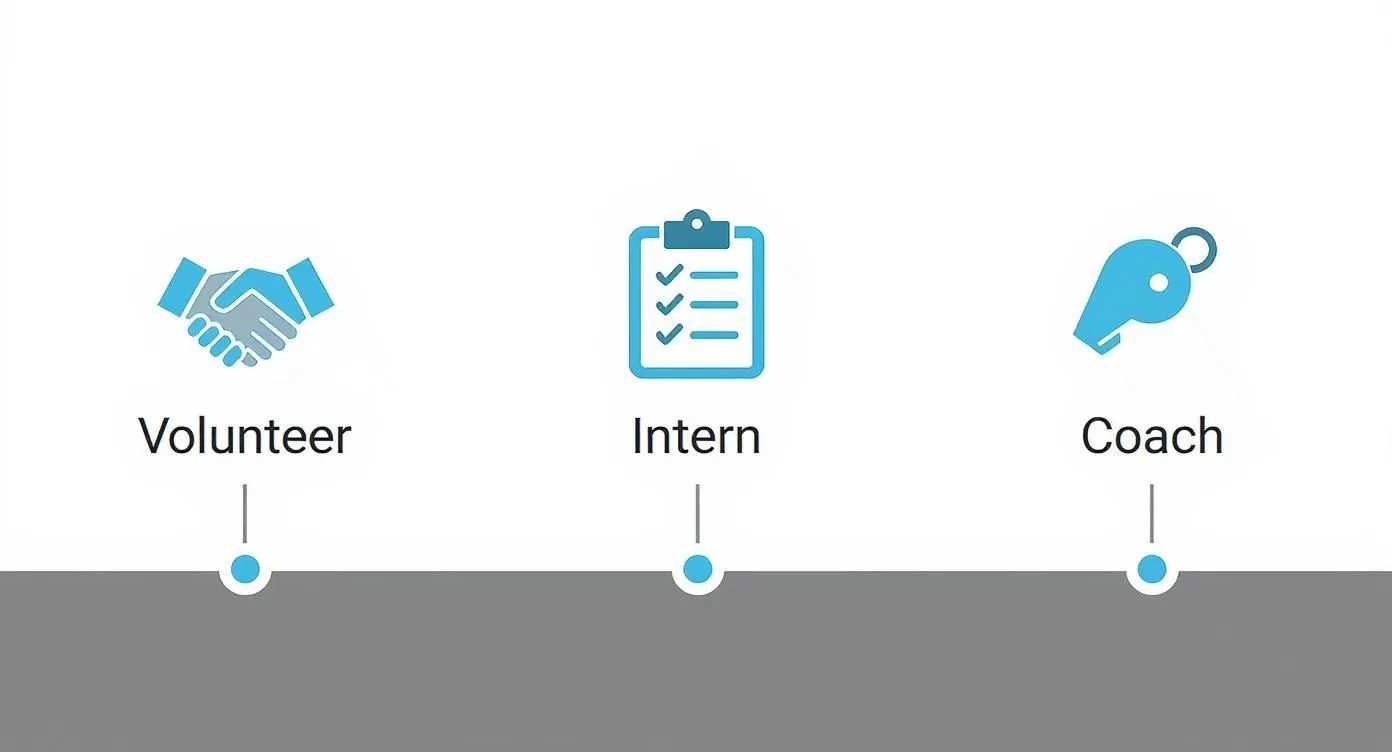
Think of those early internships as the bridge to your first real coaching gig. It's where you prove you belong.
Mapping Out Your Professional Niche
The core principles of S&C don't change, but how you apply them certainly does. The way you train a Division I football team is worlds apart from how you'd prepare a special forces operator or a high school volleyball team.
Here are the main arenas where you can build your career:
- Collegiate Athletics: This is the most common path for a reason. You can find roles from Graduate Assistant all the way up to Head S&C Coach. It's a structured environment where you get to focus on long-term athletic development and really see your impact on team performance.
- Professional Sports: For many, this is the big leagues. You're managing elite athletes whose bodies are their livelihood. The pressure is intense and you need to be a true specialist in your sport, but the resources and potential rewards are unmatched.
- Private Sector: Think performance gyms training everyone from local youth stars to weekend warriors. This route gives you a ton of autonomy and the chance to be an entrepreneur. You're building your own brand and client list from the ground up.
- Tactical Strength and Conditioning: This field is blowing up. You'll be training military, firefighters, and police officers. It's not about game-day performance; it's about preparing tactical athletes for the life-or-death physical demands of their jobs.
Understanding Your Earning Potential
Let's talk money. Your salary can swing wildly depending on your job title, location, the sport you're in, and the level of competition. As you gain experience and take on more leadership, your pay will climb, but it's crucial to have a realistic grasp of the numbers from the start.
Your first few years are an investment. A Graduate Assistant or intern position might only offer a small stipend and a tuition waiver instead of a full salary. The experience, connections, and mentorship you gain are the real currency.
The collegiate setting is a great benchmark for salary expectations. Here's a general breakdown of what you might see:
| Position Level | Typical Salary Range (USD) | Key Responsibilities |
|---|---|---|
| Graduate Assistant | $10,000 - $20,000 (plus tuition) | Assisting with teams, cleaning the weight room, data entry |
| Assistant Coach | $40,000 - $70,000 | Leading training for your assigned teams, implementing programs |
| Head Coach (Mid-Major) | $60,000 - $90,000 | Overseeing all teams, managing assistant coaches, program design |
| Head Coach (Power 5) | $100,000 - $700,000+ | Running a large department, high-level strategy, fundraising |
The good news is that the demand for good coaches is growing. The global number of trainers and coaches recently topped 740,000, which is a 4.4% annualized jump from 596,000 just nine years ago. This shows that organizations are finally recognizing the value of expert coaching.
Ultimately, you get to chart your own course. Whether you're drawn to the roar of a packed stadium or the focused hum of a private training facility, there are great opportunities out there for coaches who are willing to work for them. As you climb the ladder, you can explore the various companies hiring in the sports industry to find the perfect fit for your ambitions.
From Resume to Handshake: Mastering Your Job Search
Getting the right degree and certification will get your foot in the door, but a polished application and a killer interview are what actually land you the job. This field is incredibly competitive. A generic resume and a canned coaching philosophy just won't cut it.
You need to show up as a thoughtful, professional problem-solver who can bring immediate value to an athletic program. Every piece of your job search, from the first sentence of your cover letter to your final handshake, has to be intentional. The goal is to show the hiring committee not just what you know, but how you think, communicate, and connect with athletes and staff.
Crafting a Resume That Actually Gets Read
Let's be real: hiring managers spend seconds, not minutes, scanning a resume. Your job is to make every second count. Do this by showcasing quantifiable achievements, not just listing past duties.
Vague statements like "Assisted with football team" are a fast track to the "no" pile. Instead, you have to demonstrate real, tangible results. Think in numbers and specific contributions. How many athletes were on your roster? What specific technology did you use for athlete monitoring? What measurable improvements did you help create?
Here's How to Transform a Resume Bullet Point:
- Before: Coached athletes during summer training.
- After: Designed and implemented an 8-week summer strength program for 45+ multi-sport high school athletes, leading to an average 10% increase in vertical jump and a 15% improvement in pro-agility times.
See the difference? The "after" version tells a compelling story. It gives them context, scale, and measurable success, making you a much more interesting candidate. For more ideas on how to build a powerful application, check out the articles on the GetSportJobs blog, which cover all sorts of career development topics in the sports world.
Nailing Your Coaching Philosophy
At some point in the interview, you will be asked, "So, what's your coaching philosophy?" This isn't a pop quiz—it's a window into your values, your methods, and your personality. A generic answer about "hard work" is a massive missed opportunity.
Your philosophy should be a tight, authentic summary of your core principles. It needs to hit on a few key areas:
- Your "Why": What's the ultimate point of your coaching? Is it pure performance? Injury prevention? Building character? Be specific.
- Your "How": What are your non-negotiable training principles? Do you prioritize movement quality above all else? Are you data-driven? Do you lean heavily on autoregulation?
- Your "Who": How do you build rapport and get buy-in from athletes? How do you adapt your communication style for different personalities and sports?
A strong coaching philosophy is your professional compass. It guides your programming, your interactions, and your decisions under pressure. It's not just something you say in an interview; it's what you live out on the weight room floor every single day.
Practice saying your philosophy out loud. Get comfortable with it until it sounds natural, not like you're reading a script. It should be a confident, 60 to 90-second explanation that gives the hiring committee a clear picture of who you are as a coach.
Finding the Right Opportunities
Knowing where to look is half the battle. Sure, you can find listings on the big, general job boards, but specialized platforms are far more efficient. They put you directly in touch with the teams and organizations you actually want to work for.
The bar is getting higher, especially in top-tier sports. The NCAA, for instance, now mandates that all full-time Division I S&C coaches must hold an accredited certification like the CSCS or SCCC. This move highlights the industry's push for higher professional standards and athlete safety, and it's a trend that's here to stay.
Finally, never, ever underestimate the power of your network. Attending industry events like the NSCA National Conference isn't just about collecting continuing education credits; it's about connecting with people. The relationships you build with other coaches are often the inside track to your next great job.
Answering Your Top Questions About This Career
You've seen the roadmap, but let's be real—you probably still have some big questions floating around. What's this really going to take? Let's break down some of the most common things aspiring coaches ask, getting straight to the point on the timeline, costs, and what it takes to switch careers.
How Long Does It Realistically Take to Become a Coach?
There's no magic number, but a realistic timeframe from starting your degree to landing that first full-time, paid coaching job is typically 5 to 7 years.
Think of it in stages. First, you have your four-year bachelor's degree. You should be using that time to get your feet wet with volunteer or observation hours. After you toss your graduation cap, you'll need another one to two years for the real grind—that's when you're deep in internships or a graduate assistantship, all while studying for and nailing your certification exam.
This isn't just about checking boxes on a resume. The time it takes is directly tied to the quality of your hands-on experience and the professional network you're building every single day.
What Are the Total Estimated Costs?
Becoming a strength and conditioning coach is a serious investment in your future. The final price tag will obviously depend on your school and location, but let's look at the major costs you need to plan for beyond just tuition.
Here's a rough breakdown of what you can expect:
- Bachelor's Degree: This is your biggest ticket item. It can run anywhere from $40,000 for an in-state public school to over $200,000 for a private university.
- CSCS Certification: The exam itself costs $340 if you're an NSCA member and $475 if you're not. Don't forget to budget for study materials, which can easily add another $200-$300.
- CPR/AED Certification: This is a non-negotiable prerequisite for almost any major certification. It's a small but necessary expense, usually between $50 and $100.
- Internship Expenses: Here's a hard truth—many of the best internships, especially in college athletics, are unpaid. You'll need to have a plan to cover your own living expenses like rent and food for anywhere from a few months to a full year.
Can I Make a Career Change Into This Field?
Absolutely. Plenty of fantastic coaches come from completely different professional backgrounds, and they often bring a unique perspective and maturity to the weight room. But you have to be smart and strategic about it.
If you're looking to make the leap, start by taking a hard look at your education. If your degree has nothing to do with exercise science, you'll likely need to knock out some prerequisite courses in anatomy, physiology, and biomechanics. This is often a requirement to even sit for top-tier certifications like the CSCS.
At the same time, dive into the practical side immediately. See if you can volunteer with a local high school team on weekends or find a veteran coach at a private facility who will let you shadow them. This shows you're serious and starts building your coaching resume while you handle the academic side of things. It's definitely a marathon, not a sprint, but it's 100% doable with a solid plan.