How to Become a Sports Agent A Career Playbook
If you think becoming a sports agent is all about glamour, courtside seats, and big paydays, you're only seeing the highlight reel. The real work is a relentless grind built on legal knowledge, razor-sharp negotiation skills, and a genuine passion for your clients' success. It’s a high-stakes career, and this is your game plan for breaking in.
Your Playbook for a Career in Sports Agency
Let's get one thing straight: being a sports agent is far more than just negotiating contracts. You're part business manager, part legal advisor, part marketing guru, and often, part therapist. You're the person responsible for building an athlete's career from the ground up and ensuring their financial security long after the cheering stops.
This job demands an intimate knowledge of everything from contract law and financial planning to public relations and brand strategy. You'll spend countless hours scouting talent, building real relationships with team executives, and hammering out deals where every single clause matters. The pressure is intense and the competition is cutthroat, but the chance to shape an athlete’s entire future is an incredible responsibility.
What Does It Really Take?
First things first, you need the right foundation. Most successful agents start with a bachelor's degree in a relevant field like sports management, business, or finance. If you're serious about representing top-tier pros, you'll see many agents go a step further with an advanced degree like an MBA or, very commonly, a Juris Doctor (JD). A law degree isn't just a piece of paper; it's a massive advantage in a world built on contracts. You can explore different educational pathways for sports agents to see what makes the most sense for you.
But here’s the thing—academics only get you so far. This industry runs on relationships. Trust is your currency.
An agent's true role is to be a fierce advocate and a steady advisor. You’re not just negotiating a contract; you're managing a career, a brand, and often, a lifelong dream.
Laying the Groundwork for Success
Your path won't be a straight line. It's about making a series of smart, strategic moves that build on each other. It’s less about what you know and more about who you know and how you use that knowledge.
Here are the non-negotiables:
- Get Your Foot in the Door: Internships are everything. Work for an agency, a team, or a sports law firm. This is where you'll learn the real rhythm of the business and start building a network that matters.
- Get Certified: You can't just decide to represent an NFL player. Every major professional league—the NFLPA, NBPA, MLBPA—has a rigorous certification process. This usually involves an application, a background check, and a tough exam.
- Find Your Niche: Are you all about football? Do you see a huge opportunity in women's soccer or the exploding world of esports? Specializing helps you become a true expert and makes you stand out in a crowded field.
This is a realistic look at the dedication it takes. It’s a tough road, but the potential to build a career you're passionate about is absolutely there for the taking.
Building Your Foundation with Education and Licensing
Before you can even think about negotiating those massive, life-changing contracts for an athlete, you have to lay the groundwork. The road to becoming a top sports agent is built on a solid foundation of the right education and the proper legal credentials. It’s not just about getting a piece of paper; it’s about arming yourself with the knowledge and authority to actually represent a professional athlete.
While there isn't one single, mandatory degree to become an agent, some academic routes give you a serious head start. Think of your college education as your first training camp—it’s where you develop the fundamental skills you'll need to navigate the incredibly complex world of sports business and law.
Choosing Your Educational Playbook
The major you choose can shape your entire career and the kind of expertise you bring to the table. A degree in Sports Management is a popular choice because it gives you a 30,000-foot view of the entire industry, from marketing and endorsements to event operations. It’s a great way to understand the ecosystem your future clients will be living in.
A Business or Finance degree, on the other hand, hones your skills on the money side of things. You’ll get a deep dive into investment principles, wealth management, and corporate sponsorships—all absolutely critical when you're advising an athlete on how to manage their earnings for the long haul. Honestly, being able to read a balance sheet is just as vital as being able to read a scouting report.
Then you have what many consider the gold standard: a Juris Doctor (JD), or a law degree. While it’s not a strict requirement for every agent, having that legal background is a game-changer. It gives you an unmatched understanding of contract law, negotiation tactics, and dispute resolution, which provides incredible credibility with both athletes and team front offices.
This table breaks down some of the most common educational paths and what they offer.
Educational Pathways for Aspiring Sports Agents
| Degree Program | Core Focus | Key Skills Gained | Ideal For |
|---|---|---|---|
| Sports Management | The business of sports, marketing, event management, and sports law basics. | Industry knowledge, networking, event coordination, marketing strategy. | Those who want a broad, industry-specific foundation. |
| Business/Finance | Financial analysis, investment, accounting, and corporate strategy. | Financial literacy, negotiation, risk assessment, wealth management. | Aspiring agents who want to specialize in financial advising and contract value. |
| Law (Juris Doctor) | Contract law, negotiation, litigation, intellectual property, and labor law. | Legal expertise, critical thinking, contract drafting, advocacy. | Individuals aiming for top-tier representation where complex legal issues are common. |
| Communications/PR | Media relations, branding, public speaking, and crisis management. | Brand building, media training, storytelling, communication skills. | Those who excel at marketing and managing a client's public image. |
Each path provides a different lens through which to view the industry, so it's about matching your education to the type of agent you aspire to be.
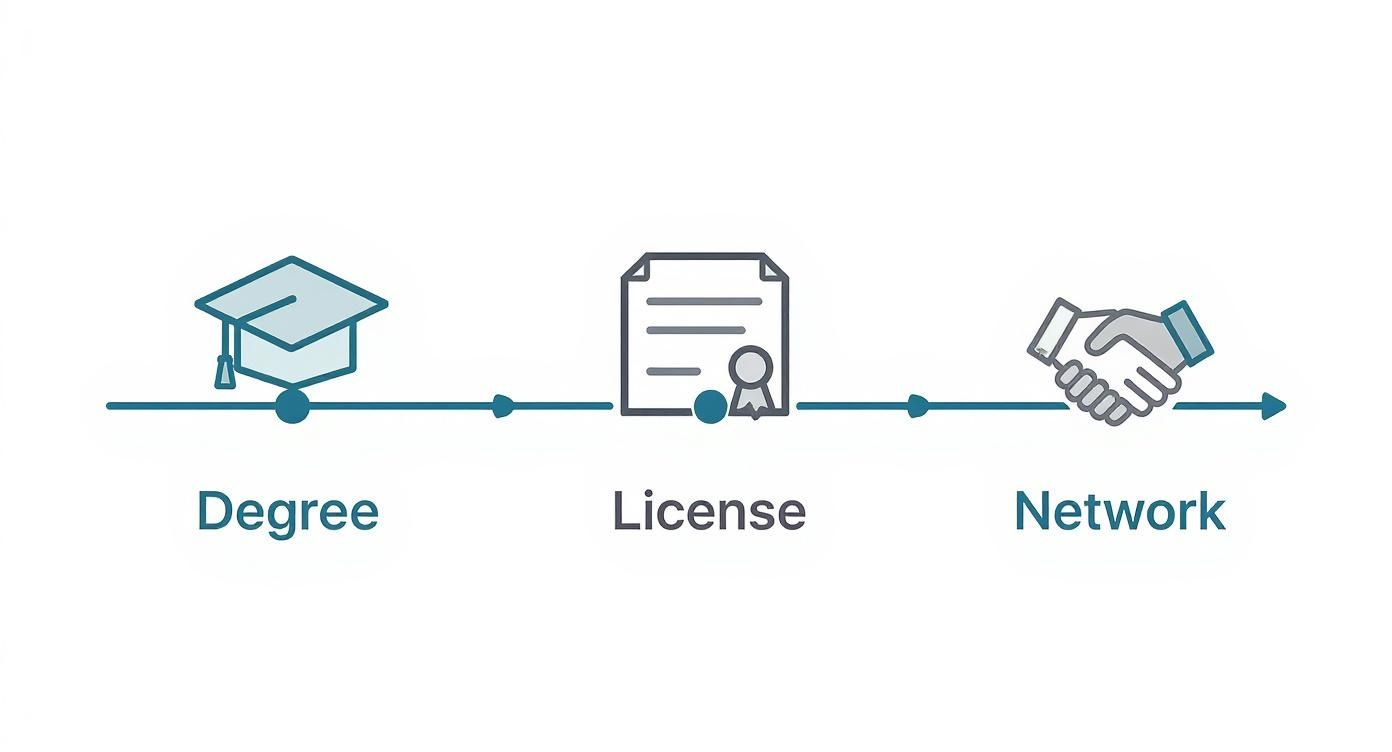
As you can see, the journey is a step-by-step process. Each stage, from your degree to getting certified and building your network, builds on the one before it.
Securing Your License to Operate
A degree might get your foot in the door, but it’s a license that gets you a seat at the negotiating table. You can’t just hang a shingle and start signing players. Nearly every professional sports league has a strict certification process run by its players’ association.
And trust me, these aren't just a formality. They are a rigorous vetting process designed to protect the players. To get certified, you'll generally have to:
- Submit an exhaustive application, which almost always requires a post-graduate degree.
- Pay a hefty, non-refundable application fee. The NFLPA, for example, charges $2,500 just to apply.
- Undergo a thorough background check to prove you meet the league's ethical standards.
- Pass a notoriously difficult written exam covering the league’s collective bargaining agreement (CBA), salary cap intricacies, and agent regulations.
Getting your agent certification is the official green light. It’s proof that you’ve mastered the complex rulebook of the league and are qualified to represent a professional athlete’s best interests.
If you don't get certified, you are legally prohibited from representing players in that league. Simple as that. And remember, each sport has its own union—the NFLPA, NBPA, MLBPA, NHLPA—and you need to be certified by every single one you want to work in.
The Non-Negotiable Role of Internships
Book smarts are great, but they don't mean much without real-world reps. Internships are where the theory you learned in the classroom meets reality. There is simply no substitute for hands-on experience at a sports agency, a sports-focused law firm, or even within a team's front office. This is where you really learn the business.
Platforms like GetSportJobs are designed to connect aspiring pros with these make-or-break opportunities. They pull together internships and entry-level jobs from across the industry, making your search much more focused.
A good internship isn't about getting coffee. You'll be thrown into meaningful work, like:
- Digging into player stats and researching comparable contracts for negotiations.
- Helping put together marketing decks and outreach materials for potential clients.
- Sitting in on client meetings and watching how senior agents prepare for a negotiation.
- Building your own network of contacts with other interns, scouts, and industry insiders.
This experience is pure gold for your resume. To make sure you’re highlighting it effectively, it’s a good idea to get a free analysis of your sports industry resume to see where you can make it stronger. In a field this competitive, a polished, industry-specific resume can be the thing that sets you apart.
Mastering the Core Skills of a Top Agent
Getting the right degree and license gets your foot in the door, but it doesn't guarantee you'll win the game. To really make a name for yourself as a sports agent, you need to master a set of practical skills that you’ll never learn in a classroom. These are the abilities that build careers, secure futures, and draw the line between an average agent and an elite one.
This job is so much more than knowing the rules. It’s about knowing how to play the long game for your client—being a masterful negotiator, a shrewd financial guide, and a brilliant brand strategist all rolled into one.
The Art of High-Stakes Negotiation
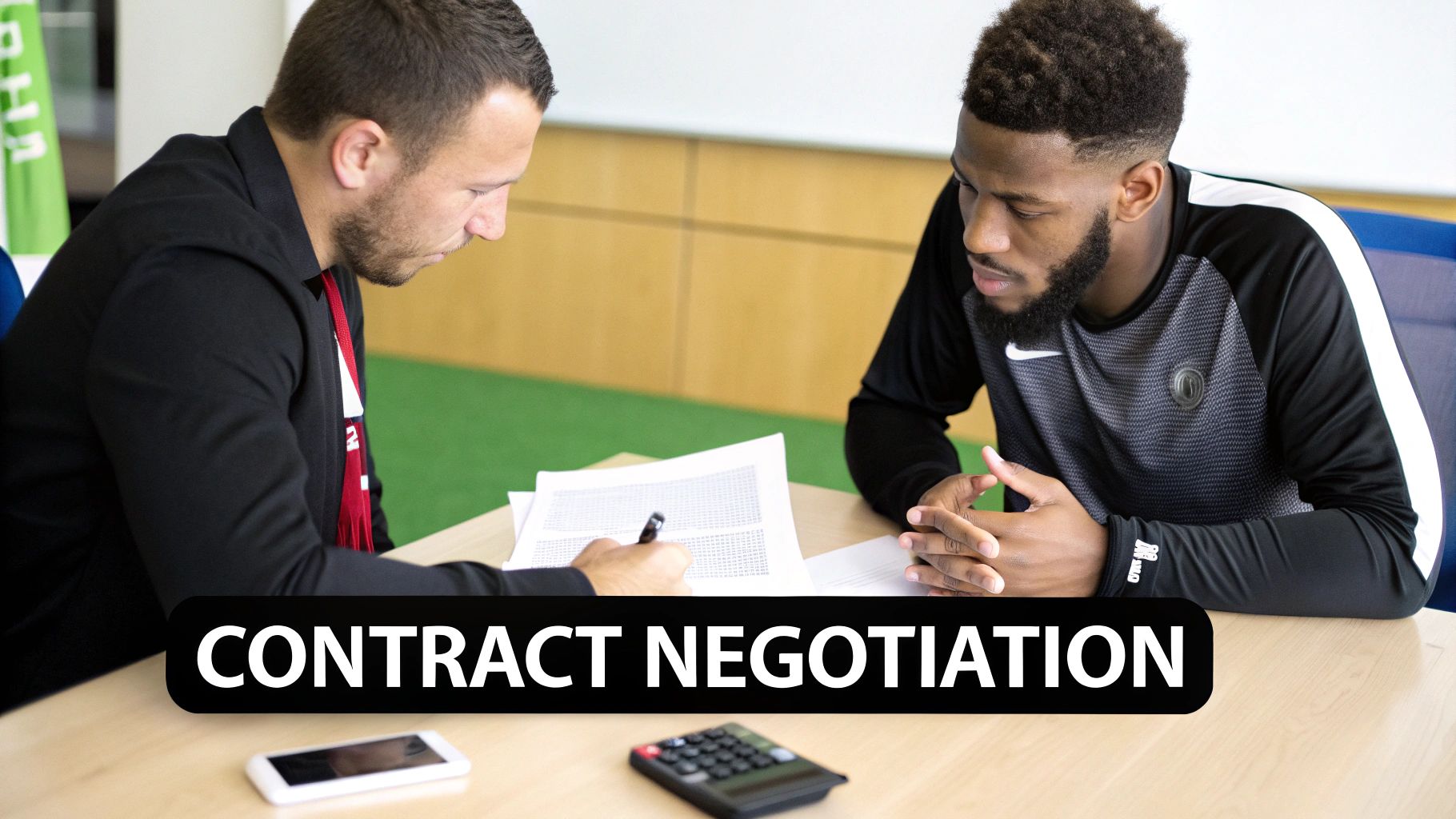
At its heart, the job of a sports agent is to be a world-class negotiator. You are your client’s champion at the bargaining table, fighting for every single dollar and clause that will move their career forward. This demands an encyclopedic knowledge of the league’s Collective Bargaining Agreement (CBA), salary cap intricacies, and the going rate for talent.
Let's say you're negotiating for a star wide receiver. You don't just walk in and ask for a huge salary. You show up armed with data on comparable player contracts, a deep dive into the team’s available cap space, and a clear strategy. You might use an offer from a rival team to drive up the price or structure the deal with performance bonuses that reward your client for hitting specific milestones, like Pro Bowl selections or a certain number of touchdowns.
The details are everything here. Agents are negotiating player contracts that can be worth tens of millions annually. For instance, top-tier NBA or NFL player contracts can soar past $50 million per year, with endorsements tacking on millions more. Agents typically earn a 3% to 10% commission on these deals, which makes razor-sharp negotiation skills incredibly valuable.
A great contract isn't just about the biggest number. It's about security, incentives, and a structure that protects your client both on and off the field. It’s your job to think five years ahead, not just about next season’s paycheck.
Guiding Your Client's Financial Future
One of the biggest rookies mistakes an aspiring agent can make is thinking the job is done once the ink on the contract is dry. Far from it. Top agents know that an athlete’s career is incredibly short, and a huge part of their responsibility is helping to secure that client's long-term financial stability.
This doesn't mean you need to be a certified financial planner, but you absolutely have to be financially literate. You need to confidently advise your clients on the importance of smart investing, tax planning, and just plain responsible budgeting. The sports world is littered with tragic stories of athletes who earned millions and ended up with nothing.
Your role is to assemble a trusted team of financial advisors and accountants. A key part of your job is understanding comprehensive financial planning for athletes so you can guide them on their unique journey. Think of yourself as the quarterback of their entire professional life, and that definitely includes their finances.
Building a Powerful Personal Brand
In today's market, an athlete's value stretches way beyond the field or the court. Their personal brand is a massive asset, and a top agent essentially acts as their chief marketing officer, building that brand from the ground up. This is where you can create revenue streams that often rival—and sometimes even surpass—their playing salary.
This involves juggling several key activities:
- Securing Endorsement Deals: You'll be identifying and pitching brands that are a natural fit for your client's image, negotiating everything from major shoe contracts down to commercials for the local car dealership.
- Managing Public Image: This is about more than just a good reputation. It includes hands-on media training, carefully curating their social media presence, and navigating potential PR crises. A single misstep can tarnish a brand, and you are the first line of defense.
- Creating Original Content: Modern agents often help athletes launch their own podcasts, YouTube channels, or other media ventures. These platforms connect them directly with their fanbase and build serious brand equity for the long haul.
For example, if you represent a charismatic young quarterback, you might focus on landing a national deal with a sports drink company while also helping him launch a youth football camp in his hometown. Every move is strategic, designed to build a positive, marketable, and lasting image. Pulling this off requires a potent mix of creativity, salesmanship, and an instinct for what brands are really looking for.
Many of these duties, particularly contract negotiation and brand management, wade into complex legal territory. That's why so many successful agents either have a law degree or work hand-in-glove with legal pros. If the legal side of sports fires you up, it’s worth exploring the various legal roles available in the sports industry to see how those skills overlap with an agent's work.
How to Build Your Client Roster and Agency
You've got the education and the licenses squared away—congratulations, you’re officially in the game. But now comes the part they don't teach you in a classroom: actually signing clients. This is where the real work begins, and your success as a sports agent will be defined by your hustle, your network, and your ability to build trust.
Forget just being a fan in the stands. Your first real move is to embed yourself in the athletic community. Attending games is a start, but it's not enough. You need to build genuine, lasting relationships with the key influencers in a young athlete's life: their college coaches, high school mentors, trainers, and, most importantly, their family. These are the people they trust, and their opinion of you matters.

Effective Networking and Client Recruitment
Recruiting doesn't start the day an athlete becomes draft-eligible. It begins months, sometimes years, before, by providing value without expecting anything in return. Offer to connect a coach with a conditioning specialist you know. Share an interesting article on new training methods. Simply be a reliable, helpful presence they remember.
When it's finally time to reach out to a potential client, your approach has to be sharp and personal. Generic, templated emails are a waste of time—they get deleted immediately. You have to show you've done your homework.
A strong, effective outreach email should hit these points:
- Show You’re Paying Attention: Mention a specific play, a key statistic, or a recent achievement. Something like, "Your vision on that cutback run in the third quarter against State was exceptional," proves you're not just spamming a list.
- State Your Value Clearly: What do you actually do for them? This goes way beyond just negotiating a contract. Touch on brand development, financial planning, and setting them up for a long-term career.
- Keep it Low-Pressure: End with a simple, informal call to action. Suggest a quick chat to talk about their goals, not a formal pitch to sign with you. Frame it as a conversation.
The best agents are relentless networkers who build reputations based on trust, not transactions. Your first impression with an athlete and their family sets the tone for your entire potential relationship.
This proactive, relationship-first approach is critical in a field that's exploding. The global sports agency services market is currently valued at around USD 5.88 billion and is projected to hit USD 15.17 billion by 2034. North America is a huge piece of that pie, generating over USD 1.44 billion in 2024 alone. The opportunity is massive, but only for agents who can build a solid roster. You can see the full breakdown in the sports agency market growth research from Business Research Insights.
To Join an Agency or Build Your Own?
One of the first major forks in the road you'll face is whether to join an established agency or go it alone. There's no single right answer here; it really comes down to your personality, resources, and tolerance for risk.
Signing on with a big firm like CAA, Wasserman, or Klutch Sports Group gives you instant credibility and a powerful support system. You get mentorship from veteran agents, access to administrative staff who handle the grunt work, and a famous brand name that opens doors. The trade-off? You'll have less autonomy and will take home a smaller slice of the commission pie.
On the flip side, launching your own agency gives you total freedom and a much bigger financial upside—you keep 100% of the commission. You build your own brand and call all the shots. But don't underestimate how tough this path is. You are the CEO, the recruiter, the negotiator, the marketer, and the accountant, all rolled into one.
Here’s a quick look at how the two paths stack up:
| Aspect | Joining an Established Agency | Starting Your Own Agency |
|---|---|---|
| Resources | Full access to legal, marketing, and admin teams. | You're on the hook for building or outsourcing everything. |
| Mentorship | Learn directly from seasoned, successful agents. | You have to figure it out as you go. |
| Income | A smaller commission split but a more stable start. | Higher earning potential but with major upfront costs and risk. |
| Autonomy | Follow the agency's strategy and client assignments. | Complete control over your brand, clients, and decisions. |
| Brand Recognition | Instant credibility from a well-known name. | Your reputation starts and ends with you. |
Laying the Foundation for Your Own Firm
If you choose the solo route, you need to think like an entrepreneur, not just an agent. Your first order of business is setting up a proper legal structure. Most independent agents form a Limited Liability Company (LLC), which is a smart move to protect your personal assets if the business ever runs into debt or legal trouble.
Next, you need a business plan. This isn't just a formality; it's your strategic roadmap. It should clearly outline your:
- Mission and Vision: What kind of agent will you be? What are your values?
- Target Market: Which sports will you focus on? Are you targeting top draft picks or under-the-radar talent?
- Financial Projections: Be realistic about your startup costs, living expenses, and when you expect to become profitable.
- Marketing Strategy: How, exactly, are you going to find and sign those first few crucial clients?
Building an agency from scratch demands skills far beyond representation. If you're serious about this path, getting experience in other roles in sports management can be a game-changer. Working in operations, finance, or marketing gives you a 360-degree view of the business, which is exactly what you'll need to turn your startup into a thriving agency.
Navigating Industry Challenges for Long-Term Success
Getting your foot in the door as a sports agent is tough, but building a career that lasts is the real challenge. The industry is littered with agents who burned bright and fast. Long-term success isn't just about landing that first big client; it's about navigating a world of brutal competition, murky ethical waters, and the relentless pressure to prove your worth.
This isn't a job you can phone in. It demands a sharp eye, a rock-solid moral compass, and an absolute dedication to your clients' lives, both on and off the field.
Standing Out in a Hyper-Competitive Market
Let's be blunt: the market is saturated. For every top-tier prospect, there are literally hundreds of agents trying to get their attention. A license and a slick business card mean nothing. You have to bring something different to the table, a unique value that speaks directly to athletes and the people they trust most.
Your reputation is everything. It's built brick by brick through trust, honesty, and a proven ability to get things done. Instead of chasing every big name out there, focus on building real, meaningful relationships with a handful of clients. Give them unparalleled, personal service. That's how you get the best marketing in the business: word-of-mouth referrals from happy clients.
Maintaining Ethical Integrity
The sports agent world has a reputation for a reason. You will find yourself in situations that test your principles—from tempting conflicts of interest to the pressure to offer improper perks to land a signature. If you want to build a career with any staying power, navigating these ethical minefields is non-negotiable.
You have to maintain strict professional boundaries. You’re a trusted advisor, not just another friend in their entourage. This means you need to be ready to have the hard conversations—about money, about behavior, about tough career choices—even when it's the last thing you or your client wants to hear.
Your integrity is the one thing you can't afford to lose. One ethical slip-up can torch a reputation you spent years building, making it virtually impossible to sign new clients or keep the ones you have.
Protect yourself and your clients by putting everything in writing. Clear, transparent communication is your best defense. Document every important conversation and make sure your clients truly understand every line of their contracts and financial plans. It’s not just good business; it’s a sign of respect.
The Critical Importance of Client Retention
Signing a client feels like the finish line, but it’s really just the start. Retaining that client is how you build a stable, thriving business. A classic rookie mistake is pouring all your energy into recruiting and then coasting once the ink is dry. That's a surefire way to get fired. Athletes will drop an agent in a heartbeat if they feel ignored or undervalued.
So, how do you keep them? It really comes down to three things:
- Proactive Communication: Don't make them chase you for information. Be the one calling with regular updates on endorsement deals, contract talks, and what's happening in the market.
- Delivering Continuous Value: Your job didn't end when the contract was signed. You should be constantly looking for marketing opportunities, supporting their off-field passions, and, most importantly, helping them plan for life after the game.
- Building Genuine Trust: Strive to be the first person they call for advice on anything. When you build that level of trust, a simple business arrangement transforms into a lasting partnership.
It's absolutely vital to remember how fleeting an athlete's career can be. The average career of an NBA player, for example, is shockingly short. Your role is to help them make the most of that limited window while simultaneously preparing them for what comes next.
Adapting to a Constantly Evolving Industry
The sports world is always in motion. Collective Bargaining Agreements (CBAs) get overhauled, league rules shift, and new technologies change how athletes engage with fans and brands. To be an effective agent, you have to be a student of the game for life.
Staying ahead means you're constantly reading industry news, showing up at conferences, and building your network. You need to know what's coming around the corner. Think about the explosion of NIL (Name, Image, Likeness) in college sports—it completely changed the game for young athletes and their agents. The agents who saw it coming and prepared for it are thriving. Those who were slow to react got left in the dust.
Ultimately, handling these challenges is what separates the elite agents from everyone else. It takes a unique mix of business savvy, unwavering ethics, and a genuine, personal drive to see your clients win in every aspect of their lives.
Common Questions About a Sports Agent Career
Even with a solid plan, you're bound to have questions. The path to becoming a sports agent is full of them. I've heard the same ones come up time and time again from people just starting out, so let's tackle the big ones head-on.
How Much Do Sports Agents Actually Make?
Forget about a steady paycheck. An agent's income is almost entirely based on commissions, so your earnings are directly tied to the deals you close for your athletes. You're eating what you kill, so to speak.
These commission percentages are capped by the players' unions and usually hover somewhere between 3% and 10%. For example, if you negotiate a $10 million contract for a player and your commission is 4%, that's $400,000 for you—but don't expect it all at once. That income is typically paid out over the life of the contract.
Top agents representing household names can pull in millions, but when you're starting out, you'll be working with up-and-coming athletes on smaller deals. Be prepared for a few lean years at the beginning.
Your income is a direct reflection of your clients' success. It’s a high-stakes, high-reward world where your ability to negotiate and build a solid roster determines everything.
Do I Absolutely Need a Law Degree?
Let's clear this up: a law degree (Juris Doctor) is not a strict requirement, but it’s a massive advantage. So much of this job comes down to contracts, legal clauses, and navigating the complex rules set by leagues and players' associations. Having a JD gives you the expertise to handle all of that with confidence.
That said, plenty of highly successful agents come from sports management, business, or finance backgrounds. If you go that route, you absolutely must have a lawyer you trust—either as a partner or on retainer—to review every single contract. No exceptions.
What Does the Day-to-Day Job Look Like?
If you're picturing a life of courtside seats and celebrity parties, you're only seeing about 5% of the picture. The reality is a grind. A typical day is a whirlwind of different tasks that all demand your immediate attention.
One day, your schedule might look something like this:
- Scouting Talent: Spending hours watching game film or sitting in the stands at college games, looking for that one player with untapped potential.
- Constant Communication: Your phone will be glued to your hand. You'll be talking to clients, team GMs, marketing reps, and financial advisors from sunup to sundown.
- Negotiation Prep: Digging into salary data for comparable players and analyzing a team's salary cap situation to build your strategy for a contract negotiation.
- Brand Management: Pitching your clients to brands for endorsement deals, helping manage their social media, and coordinating public appearances.
- Problem-Solving: Putting out fires. This could be anything from a client's personal issue to dealing with a bad press story.
This is a 24/7 gig. When your client needs you, you have to be there, whether it's a Tuesday morning or a Saturday night. It's demanding work, but it's never, ever boring.
How Long Does It Take to Get Established?
Building a career as a sports agent is a marathon, not a sprint. Realistically, expect it to take five to ten years to build a stable of clients and earn a solid reputation in the industry.
The first few years are all about laying the groundwork: getting experience through internships, securing your certifications with the players' associations, and networking like your career depends on it—because it does. You have to be patient, persistent, and play the long game.
Ready to make your first move in the competitive world of sports? The right internship or entry-level job can be the perfect launchpad. GetSportJobs is a great resource for finding opportunities with agencies, teams, and leagues. Start your search today and begin building your foundation.