How to Become Sports Agent: A Modern Playbook for how to become sports agent
Being a sports agent is so much more than what you see in the movies. It's about taking raw, incredible talent and shaping it into a career, a brand, and a legacy. This path isn't just about sharp suits and tough negotiations; it's a demanding blend of business strategy, legal expertise, and a whole lot of hustle. Getting started means committing to education, getting certified, and building a network from scratch.
Your Roadmap to Becoming a Modern Sports Agent

Let's get one thing straight: the old-school agent who just haggled over contracts is a dying breed. The most successful agents today are essentially the CEO of their client's entire professional enterprise. You're not just a negotiator; you're a career architect, brand manager, financial advisor, and confidant, all rolled into one. You're managing everything from massive endorsement deals to making sure your client's long-term financial future is secure. This is a hyper-competitive world, and you need to be prepared to manage every facet of an athlete's life.
This guide will give you the real-world blueprint for what it takes. We're cutting through the Hollywood fluff to give you the actionable strategies and skills that actually build a sustainable career in this business.
What the Modern Agent Actually Does
The job description has exploded. Yes, securing top-dollar playing contracts is still the bedrock of the profession. But the real value—and where the best agents separate themselves—is in offering a complete, 360-degree service that maximizes an athlete's earnings both on and off the field.
This evolution is happening for a reason. The global sports agency market is on a serious growth trajectory, projected to jump from $5.88 billion in 2025 to a staggering $15.17 billion by 2034. That growth isn't just coming from bigger salaries. It's fueled by new commercial rights, digital media, and the demand for sophisticated athlete branding. If you want to compete for top talent, you have to offer an integrated package that covers marketing, financial planning, and legal guidance. It's worth diving into the full market analysis and projections to grasp just how much opportunity is out there.
The agents who win today are the ones who can master contract law while also building expertise in branding, social media, and financial advisement. It's about creating a complete revenue-generation machine for your client.
Core Competencies for the Modern Sports Agent
To build a career, you need to understand where the game is played today. An agent's skillset has expanded far beyond just knowing the rulebook. The table below breaks down how the role has evolved from its traditional focus to meet the complex demands of today's athletes.
| Skill Area | Traditional Focus | Modern Requirement |
|---|---|---|
| Legal Acumen | Reading and understanding contracts. | Dissecting complex CBA language, anticipating legal pitfalls, and proactively protecting a client’s intellectual property. |
| Business Development | Securing a shoe deal. | Building a diverse portfolio of endorsements, equity deals, and content partnerships with major brands. |
| Financial Literacy | Basic budgeting advice. | Comprehensive wealth management, including investment strategy, tax planning, and post-career financial security. |
| Marketing & Branding | Arranging a magazine photoshoot. | Crafting and managing a complete personal brand across digital platforms, including social media strategy and content creation. |
Ultimately, succeeding as a modern agent means you need to be a Swiss Army knife of professional skills. You have to be as comfortable reviewing a legal document as you are pitching a brand partnership or advising on an investment.
Laying the Groundwork: Education and Essential Skills

Before you ever dream of sitting across the table from a general manager, you have to build your own foundation. Becoming a successful sports agent isn't about one magic degree; it's a strategic mix of the right education and a very specific set of people skills. Your credibility, your network, your entire career—it all starts here.
Think of your education as the first tool you pull out of your toolbox. While there's no single mandatory degree, some paths will give you a serious head start. Each one gives you a different lens through which to view the complex world of professional sports.
Picking Your Educational Playbook
A formal education does more than hang a diploma on your wall. It teaches you how to think, how to break down complex problems, and how to communicate your ideas effectively. For anyone serious about this career, a bachelor's degree is the absolute baseline. Most of the top agents you see today come from one of three academic backgrounds.
- Law Degree (J.D.): This is often considered the gold standard, and for good reason. A Juris Doctor gives you an unparalleled understanding of contracts, liability, and high-stakes negotiation tactics—the bread and butter of this job. Many of the industry's most powerful agents are attorneys because they can dissect dense legal language without having to call for backup.
- Business or Finance (MBA or Bachelor's): An athlete isn't just a person; they're a brand. A business or finance background prepares you to act as your client's CEO. You’ll learn to evaluate endorsement deals, manage their public image, and provide sound financial advice, always thinking about ROI and long-term wealth.
- Sports Management: This is the most direct route into the industry. You get a specialized education in how leagues are structured, the nuances of sports marketing, and event operations. Plus, you start building a relevant professional network from day one. To get a better sense of where this path can lead, check out our guide on the variety of careers in sports management.
Specialized programs can also give you a unique advantage. Something like an Access to Higher Education Diploma in Sports Science offers a completely different perspective, giving you a deeper grasp of athletic performance and player health.
The Skills That Can't Be Taught in a Classroom
A degree might get your foot in the door, but it's your skills that will keep you in the room. The best agents are masters of human connection and strategic thinking. Without these core skills, even the most impressive diploma is just a piece of paper.
You have to become a relentless networker. I'm not talking about collecting business cards. I mean building genuine, lasting relationships with athletes, coaches, team executives, and media members. In this business, your network is your currency.
Your success as an agent is directly proportional to the strength and depth of your relationships. Trust is the foundation of every contract you'll ever sign and every client you'll ever represent.
Beyond your ability to connect with people, three skills are absolutely non-negotiable.
- Persuasive Communication: You need to be able to articulate your client's value with conviction, whether you're pitching a brand on a sponsorship deal or haggling with a GM over a signing bonus. This means being a powerful public speaker and a sharp, concise writer.
- Unwavering Ethics and Integrity: The sports world is incredibly small, and your reputation is everything. One ethical slip-up can torpedo your entire career. Clients are trusting you with their livelihoods; your integrity has to be your most valuable asset.
- Exceptional Problem-Solving: From a client's sudden injury to a late-night PR crisis, you are the primary problem-solver. The job requires you to stay calm under immense pressure and find creative solutions when things go sideways—which they will.
Developing these skills doesn't happen overnight. It takes self-awareness, constant practice, and a real commitment to getting better every day. Start now. Look for opportunities to negotiate, lead projects, and build connections, no matter where you are.
Getting Certified and Staying Legal
Think of your degree as the ticket to the game, but the certifications and licenses? Those are your all-access pass to the locker room. You can't just decide to be an agent one day and start signing clients. Pro sports are heavily regulated, and if you want to represent athletes in the big leagues—NFL, NBA, MLB, you name it—you have to play by their rules. And that means getting their official stamp of approval.
Don't mistake these certifications for a simple formality. They are intense vetting processes put in place by players’ associations to protect their members from shady or unqualified agents. You'll be digging through paperwork to submit a detailed application, paying hefty fees, undergoing a background check, and, in most cases, sitting for a brutal exam on the league’s collective bargaining agreement (CBA).
This is your first real test. Bomb the exam, and you could be waiting a full year to try again. That’s a massive setback when you're just starting out, so preparation is everything.
Cracking the Code of Players' Association Rules
Every sport is its own universe with a unique set of laws. The NFL Players Association (NFLPA) has different agent requirements than the National Basketball Players Association (NBPA), and you need to know the rulebook for your chosen sport inside and out. These rules dictate everything from who is eligible to become an agent to how much you can earn.
Here’s a glimpse of what you're up against:
- Application Fees: Expect to pay anywhere from a few hundred to several thousand dollars, and no, you don't get it back if you're denied.
- Background Checks: They’ll be looking deep into your past for any red flags—criminal records, ethical complaints, you name it.
- Mandatory Exams: These are the real deal. They're designed to be tough, covering the nitty-gritty details of the CBA, salary cap mechanics, and agent conduct rules.
- Annual Dues & Insurance: Once you’re in, you have to pay to stay in. This includes yearly fees and, often, carrying professional liability insurance.
These regulations have a direct impact on your bottom line. Most leagues cap the commission an agent can earn on a player’s contract—usually somewhere between 2% and 10%. That’s why the sharpest agents diversify. They build their business around endorsements, marketing deals, and other opportunities where the fee structures are more flexible. To really make it, you have to become a master of these league-specific financial nuances. You can find more data on how market regulations shape agent careers in industry reports.
State Laws and the Uniform Athlete Agents Act
It doesn't stop with the players' associations. You also have to navigate a maze of state laws. Nearly every state has adopted some form of the Uniform Athlete Agents Act (UAAA), which is designed to protect student-athletes from being taken advantage of.
Break these rules, and you’re in a world of hurt. We’re talking massive fines and even potential criminal charges. If you contact a college athlete before they’ve exhausted their eligibility without following the exact notification procedures, you could destroy their career and get yourself blacklisted from the industry. You absolutely must register as an agent in every single state where you plan to recruit.
The real make-or-break challenge for a new agent is navigating where players' association rules and state laws overlap. Mastering both isn't just a good idea—it's essential for survival.
Why a Legal Mind is Your Greatest Asset
All this red tape makes it pretty clear why so many of the best agents have a law degree. While a J.D. isn't a strict requirement for every league, a rock-solid understanding of contract law, liability, and regulations is non-negotiable.
If you aren't a lawyer, your first move should be to partner with one. I mean it—this isn't optional. Every single document your client signs, from their multi-million dollar playing contract to a simple endorsement for a local car dealership, needs to be legally airtight.
The legal skills needed here are a core part of the broader sports law field. For anyone wanting to go deeper, checking out what a sports lawyer offers valuable job insights can show you the critical issues you'll face every day. You'll be dealing with everything from a client's intellectual property rights to handling disputes with a team. In the end, your reputation and your entire career depend on your ability to operate cleanly within these legal lines.
How to Find Your Niche and Build a Client Roster

Breaking into sports representation can feel like you're on the outside looking in. You see these massive agencies with rosters full of superstars and wonder, "Where do I even start?" The secret isn't trying to beat them at their own game. It's to play a different game entirely.
Your journey doesn’t start by chasing the #1 draft pick. It starts by carving out a specific corner of the sports world where you can become the absolute go-to expert. This is where you'll build your foundation, your reputation, and eventually, your client list.
Why Niche Specialization Is Your Superpower
Trying to be a jack-of-all-trades is a fast track to getting lost in the noise. The big agencies already have that market cornered. Your real power, especially when you're starting, comes from becoming the undeniable authority for a specific type of athlete, a particular sport, or even a geographic region.
This focused approach lets you build much deeper connections and offer a level of specialized knowledge that the big, generalized firms simply can't match.
Think about these kinds of powerful niche strategies:
- Emerging Sports: Look beyond football and basketball. Think about sports like professional lacrosse, women's volleyball, pickleball, and even esports. They're exploding in popularity but have far fewer agents competing for talent. You can become an authority here.
- Geographic Focus: What if you became the premier agent for athletes coming out of Texas? Or the Pacific Northwest? Your local ties to high school coaches, trainers, and families become a massive advantage that some agent in a New York high-rise can't replicate.
- Division II or III Talent: The top-tier agencies often completely overlook incredible athletes at smaller schools. By focusing on these divisions, you can uncover hidden gems with the drive and talent to play professionally, whether it's in a domestic league or overseas.
Don't get me wrong, the sports agent world is competitive. But it's also a massive market. The U.S. industry alone was pegged at $16.9 billion in 2025, with nearly 41,000 different businesses operating within it. That scale means there are countless pockets of opportunity for new agents who serve the niche markets the big players ignore. You can dig into the industry revenue and concentration data to see the full picture.
The goal isn't to be everything to everyone. It's to be everything to someone. Your niche is your foothold—the place where you can provide unmatched value and build a name for yourself.
The Art of Scouting and Building Real Relationships
Once you've zeroed in on your niche, the real work begins. Building a client roster isn’t about slick sales pitches; it's about genuine relationship-building and being a relentless scout. You have to be where the talent is, often long before anyone else is paying attention.
This means your weekends are now spent at high school showcases, college combines, and amateur tournaments. It’s about being present, being seen, and getting to know the entire ecosystem—the players, the coaches, the parents. Your first conversations shouldn't be about a contract; they should be about offering a piece of helpful advice.
Your scouting and outreach playbook should look something like this:
- Identify the Influencers: Get to know the people the athletes already trust. This means high school and AAU coaches, skills trainers, and parents. They are the gatekeepers, and if they trust you, they can become your most valuable allies.
- Give Value First: Instead of just handing over a business card, offer something useful. Help a family make sense of the dizzying recruiting process. Connect a player with a top-tier nutritionist you know. Be a resource before you ever ask to be their representative.
- Master the Follow-Up: A single conversation is just the beginning. That quick chat needs to be followed by an email, a connection on social media, and a check-in a few weeks later to see how their season is going. Consistent, genuine communication is what builds trust over time.
Crafting Your Unique Value Proposition
So, why should an athlete sign with you over an agent who's been in the game for 20 years? This is the single most important question you need to answer. Your response is your unique value proposition (UVP). It's the core of what makes you different and better for them.
A weak UVP is generic. A strong one is a specific, compelling promise that speaks directly to your niche.
For example:
- The NIL Specialist: "I work exclusively with Division I female athletes to build personal brands and secure six-figure NIL deals. My entire network is focused on brands that want to partner with strong, influential women in sports."
- The Overseas Basketball Guru: "My entire agency is built to place American guards in top-tier European leagues. I don't just shop your film around; I have personal relationships with GMs in Spain, Italy, and Germany and will fly out with you to navigate tryouts."
Your UVP is your elevator pitch, your brand, and your promise, all rolled into one. It clearly communicates that you're not just another agent—you're a specialist with a laser-focused plan to help them achieve their goals. That clarity is what will convince your first clients to put their careers in your hands.
Mastering the Art of the Deal and Managing a Career
Getting licensed and landing that first client feels like crossing the finish line, but in reality, you've just stepped into the starting blocks. The real marathon of being a sports agent is defined by two things: how you perform at the negotiation table and how you manage your client's entire career once the contract is signed.
The flashy contract signing is what makes the headlines. But the win? That happened weeks, sometimes months, earlier, buried in research and late-night prep. If you walk into a high-stakes negotiation unprepared, you're not just doing a disservice to your client—you're practically leaving a bag of their money on the table for the team to take.
Gearing Up for the Negotiation Gauntlet
Before you even think about a counteroffer, you need to build a case so solid it's practically bulletproof. This isn't about what you feel your client is worth; it's about what the data proves they're worth.
- Know the CBA Cold: The Collective Bargaining Agreement isn't just a document; it's your playbook. You need to be an expert on everything from salary caps and rookie pay scales to the nuances of performance bonuses. This is foundational.
- Arm Yourself with Analytics: Go deeper than the box score. Bring advanced stats that tell a story the other side might have missed. For a QB, maybe it's their clean pocket passing grade. For a point guard, it could be their assist-to-usage ratio.
- Compile Your "Comps": Your most powerful tool is a list of comparable contracts. Find players at the same position with similar production, age, and experience. This analysis becomes the logical foundation for your financial demands, making it hard for a GM to argue against.
Think of negotiation as a chess match, not a boxing match. It requires knowing the team's cap space, understanding their roster needs, and even getting a feel for the GM's personality. Your job is to present a scenario where your offer isn't just fair—it's the most logical move for them to make.
The Real Work: Career-Long Client Management
Here’s a hard truth: signing the deal is maybe 10% of what we do. The other 90% is the daily, year-in, year-out grind of actually managing a human being's career. This is where you earn every penny of your commission and, far more importantly, where you earn their trust for life.
Most agents don't lose clients over a bad contract. They lose them because the player felt forgotten the moment the ink dried.
Your role quickly morphs into that of a chief advisor, part-time therapist, and all-around problem solver. You're orchestrating more than just contracts; you're helping them navigate life.
Building a real, lasting relationship means becoming indispensable. You need to be the first call they make, not just for a new deal, but when they're facing an injury, a media storm, or a big personal decision.
This is the secret sauce that separates the good agents from the truly great ones. It's about showing you're invested in the person, not just the player. In the long run, your success depends on your ability to build strong client loyalty.
Before any deal is finalized, a meticulous review is essential. This checklist is a great starting point to ensure you've covered all the critical bases.
Sample Contract Negotiation Checklist
| Clause Category | Key Items to Verify | Negotiation Point Example |
|---|---|---|
| Compensation | Base salary, signing bonus, roster bonus, workout bonus. | "We need to convert $500k of the base salary into a signing bonus for immediate cash flow." |
| Incentives | Performance-based bonuses (e.g., Pro Bowl, All-Star, stat targets). | "Let's lower the snap count percentage for the playing-time incentive to a more achievable 65%." |
| Guarantees | Fully guaranteed money, injury guarantees, skill guarantees. | "The guarantee for Year 3 needs to vest on the third day of the league year, not in training camp." |
| Contract Structure | Length of contract, option years (team/player), voidable years. | "Can we add a player option for the final year to provide flexibility for a rising salary cap?" |
| Player Rights | No-trade clause, trade kicker/bonus, marketing/image rights. | "We're requesting a limited no-trade clause covering five specific teams." |
| Termination | Clauses for termination due to injury, conduct, or skill decline. | "Clarify the 'conduct detrimental' language to protect against subjective interpretation." |
Running through a checklist like this ensures no detail, big or small, slips through the cracks. It's your final line of defense for protecting your client.
Navigating the Inevitable Bumps in the Road
No career is a smooth, upward trajectory. Injuries happen. Slumps occur. Players get traded. Off-field drama pops up. How you guide your client through these crises is what truly defines your value.
When a player goes down with a serious injury, you’re the one coordinating with doctors, seeking second opinions, and poring over the contract's injury-protection language. When they're in a slump, you're the one shielding them from the media while connecting them with a sports psychologist or a new trainer.
Staying calm, strategic, and supportive when things get tough is the job. It's not glamorous—it's late-night phone calls and having conversations no one wants to have. But it's in those moments that you forge an unbreakable bond, ensuring you don't just sign clients, you keep them for life.
Your Roadmap: An Action Plan for Launching Your Sports Agent Career
Having a big dream is one thing; turning it into a real career is another. That takes a solid plan. Whether you're coming in with a law degree and a stacked contact list or starting completely fresh, you need a roadmap. Let's break down what that looks like.
The life of an agent isn't just about signing that one big contract. It’s a long-term commitment that evolves from getting the deal done to providing career-long support and building unshakable trust with your athlete.
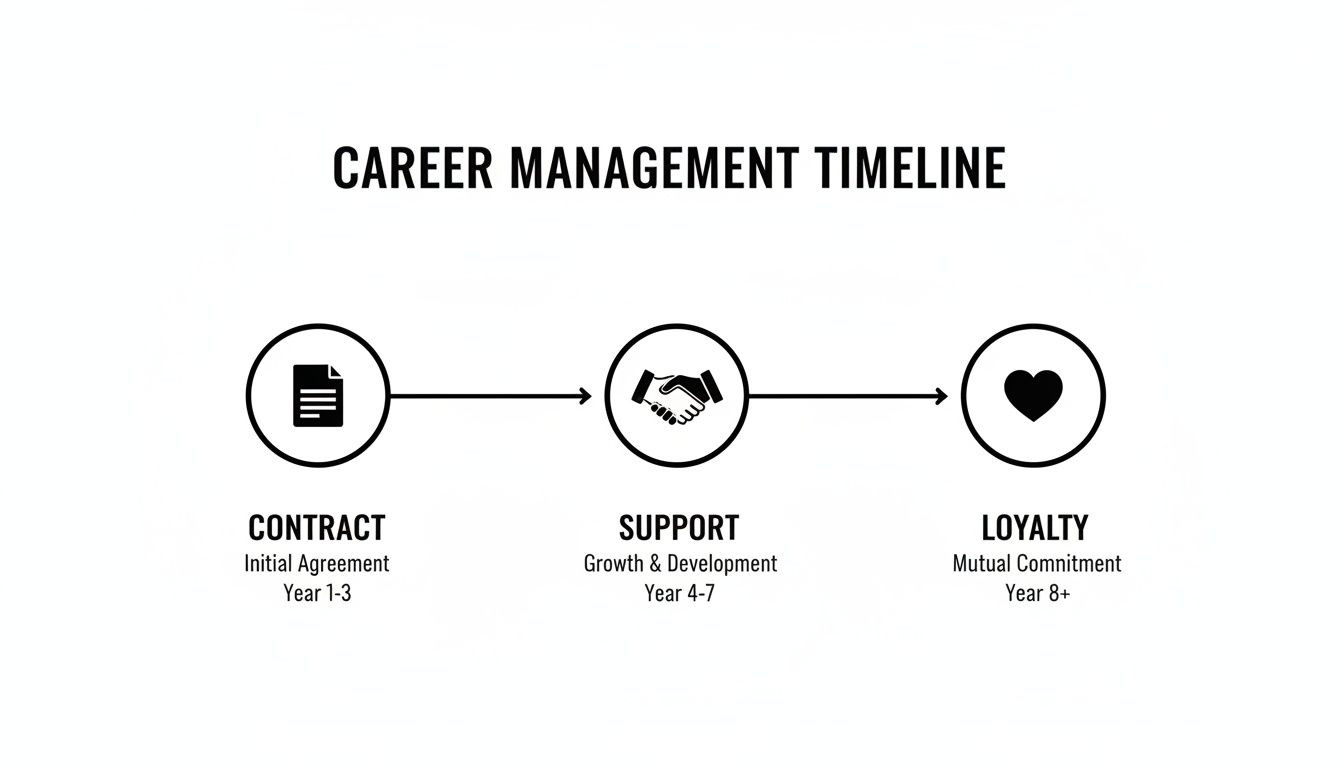
As you can see, the initial contract is just the starting line. The real work—and where you build your reputation—is in the continuous support that fosters true loyalty.
The 6-Month Fast Track
This aggressive timeline is built for those who already have a leg up—think a J.D., an MBA, or real-world experience in the sports industry.
- Months 1-2: Certify and Incorporate. Your first move is to go all-in on certification. Book your player association exam (NFLPA, NBPA, etc.) and hit the books hard. At the same time, get the ball rolling on the legal side by setting up your business as an LLC or S-Corp.
- Months 3-4: Network Relentlessly. Now, you hit the pavement. Show up at combines, pro days, showcases, and industry conferences. Set a tangible goal: have 10-15 meaningful conversations with coaches, scouts, and potential clients every single month.
- Months 5-6: Launch Your Pitch. Time to start your outreach. Use the connections and insights you've gathered to contact prospects. This isn’t a mass email blast; it's about a personalized pitch that shows exactly what you bring to the table. Your objective is to sign that first client by the end of this six-month sprint.
The 24-Month Foundational Plan
This path is for the grinders—the people starting without a specialized degree or a built-in network. And that's perfectly fine.
A Hard-Earned Lesson: Don't rush the foundation. The biggest mistake aspiring agents make is trying to sign clients before they have the education, network, or credibility to actually help them. It’s a shortcut to failure.
This longer runway is all about building from the ground up. You’ll be taking a much more deliberate approach to getting the right skills and making the right connections.
This often means getting your foot in the door with internships or entry-level jobs to learn the ropes. For more on this, our guide on how to get into sports is a great resource for mapping out those early steps.
By following a structured plan, the massive goal of becoming a sports agent gets broken down into clear, achievable steps. This is how you build a real, sustainable career in one of the most exciting fields out there.
Your Questions About Becoming a Sports Agent, Answered
If you're mapping out a path to becoming a sports agent, you've probably got a ton of questions. Let's tackle some of the most common ones that come up for aspiring agents just getting started.
Is a Law Degree a Must-Have?
This is a big one. While many of the most powerful agents are lawyers—and for good reason—a law degree (J.D.) isn't an absolute requirement across the board. It's a massive advantage for dissecting complex contracts, but plenty of top-tier agents have backgrounds in business (MBA), finance, or sports management.
The key thing to remember is this: if you don't have a J.D., you must have an ironclad grasp of contract law yourself. Or, more realistically, you'll need to partner with a sharp sports attorney to handle the legal heavy lifting. Your client's career is on the line, so there's zero room for error on legal documents.
What's the Real Earning Potential for a Sports Agent?
There’s no simple salary here; an agent's income is almost entirely commission-based. This means your earnings can swing wildly. Players' associations put a cap on how much you can take from a playing contract, usually somewhere between 2% and 10%. For example, the NFLPA sets the limit at 3%, and the NBPA caps it at 4%.
But the playing contract is only part of the story. The real money often comes from endorsements and marketing deals, where agents typically earn a much larger slice—think 10% to 20%. A new agent might just be scraping by with a few clients on smaller contracts, but an established agent representing a roster of superstars can easily clear seven figures a year.
Your biggest wins as an agent often happen off the court or field. Building an athlete's personal brand and locking in lucrative marketing deals is how you truly maximize their financial success—and your own.
How Do I Actually Land My First Client?
Getting that first "yes" is all about trust and proving you can bring real value to the table. Don't try to be everything to everyone. Instead, find a niche where you already have roots—maybe it's a sport you played, a college you attended, or a region you know inside and out.
Show up where the talent is. Go to amateur showcases, college games, and combines. Look for promising athletes who might be flying under the radar of the big-name agencies. Your approach shouldn't be a hard sell; it's about building a genuine relationship first. Offer some free, solid advice. Your first client will likely be a late-round draft pick or someone playing in a smaller league, and that's perfect. Do an incredible job for them, and your reputation will start to spread. Word-of-mouth is everything in this business.
Ready to find your place in the sports world? GetSportJobs is the ultimate resource for discovering opportunities that can launch your career. Explore hundreds of job listings in the sports industry today and take the first step toward your dream role.